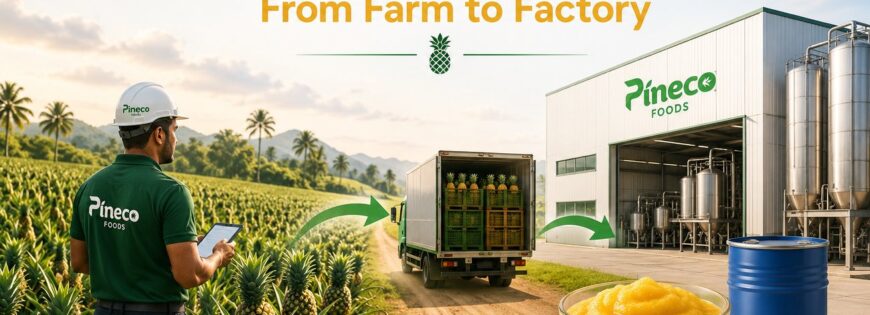
Every barrel of Pineco Foods’ premium aseptic pineapple pulp begins
its journey not in a factory, but in a sun-drenched pineapple farm in
Vazhakulam, Kerala — the heartland of India’s GI-tagged pineapple belt.
From there, a carefully controlled process transforms fresh-harvested
pineapples into consistent, high-quality, preservative-free pulp, ready
for food manufacturers across the globe.
Here is the complete, step-by-step journey of how our aseptic
pineapple pulp is made.
Step 1:
Farm-Level Sourcing — Where Quality Begins
At Pineco Foods, we work directly with a trusted network of pineapple
farmers within the Vazhakulam GI zone. Our sourcing team monitors:
-
Fruit maturity — pineapples are harvested only when Brix (sugar)
levels meet our quality threshold -
Size and variety consistency — only Queen/Kew variety pineapples
are accepted -
Farm-level hygiene and pesticide compliance — all farms are
screened for residue limits -
Harvest timing — fruits are picked in the early morning to
prevent heat damage
This direct farm-to-factory model ensures zero compromise on raw
material quality and gives us full traceability of every lot
processed.
Step 2: Reception &
Primary Inspection
Harvested pineapples arrive at our processing facility within hours
of picking. On arrival, every batch undergoes:
-
Visual inspection for external damage, overripeness, or
disease -
Brix and acidity measurement on sample lots
-
Weight and volume recording for lot traceability
-
Rejection of non-conforming batches — zero compromise on input
quality
Step 3: Washing & Cleaning
Accepted pineapples are conveyed into a multi-stage washing
system:
-
High-pressure water wash to remove field dust and surface
contamination -
Sanitising rinse using food-grade approved solutions
-
Final clean water rinse before entering the processing
line
Step 4: Peeling, Coring &
Slicing
Cleaned pineapples are mechanically processed to:
-
Remove the outer crown and base
-
Peel the outer skin using rotary peeling machines
-
Core the fruit to remove the fibrous central stem
-
Slice into uniform chunks for efficient pulping
All contact surfaces are made from food-grade stainless steel and
sanitised between batches to prevent any cross-contamination.
Step 5: Pulping
Pineapple chunks are fed into industrial pulping machines that:
-
Break down the fruit into a homogeneous pulp
-
Separate any remaining fibrous matter to the desired
consistency -
Allow production of both smooth pulp and fibre-rich textured pulp
(for crush manufacturers)
Our pulping line produces pulp of consistent Brix, colour, and
viscosity — batch after batch, season after season.
Step 6: Pasteurisation
& Aseptic Processing
This is the critical step that defines aseptic pineapple pulp. The
freshly extracted pulp is:
-
Rapidly heated to a precise temperature (UHT — Ultra High
Temperature processing) -
Held at that temperature for a specific time to destroy all
pathogenic and spoilage microorganisms -
Immediately cooled in a sterile heat exchanger
This process eliminates the need for any preservatives while ensuring
a shelf life of 12–18 months at ambient temperature. The result is 100%
natural, preservative-free, microbiologically safe pineapple pulp.
Step 7: Aseptic Filling
in 200kg Barrels
The pasteurised pulp is filled into packaging under strict aseptic
conditions:
-
200kg food-grade aseptic barrels are sterilised before
filling -
Filling takes place in a sterile, enclosed environment — no air
contact -
Barrels are hermetically sealed to maintain sterility throughout
storage and transport -
Each barrel is labelled with lot number, date of manufacture,
Brix value, and expiry date
Step 8: Quality Control
& Lab Testing
Every batch of aseptic pineapple pulp undergoes rigorous quality
control before release:
-
Microbiological testing — Total Plate Count, Yeast & Mould,
Coliform, Salmonella -
Physicochemical testing — Brix, pH, acidity, colour,
viscosity -
Sensory evaluation — colour, flavour, aroma, and texture
-
Pesticide residue analysis
Only batches that pass all parameters are cleared for dispatch.
Step 9: Storage & Dispatch
Cleared barrels are stored in a clean, dry warehouse at ambient
temperature. They are then loaded into containers for domestic or
international dispatch, with full documentation including:
-
Certificate of Analysis (CoA)
-
FSSAI compliance documents
-
Export documentation for international shipments
Why Year-Round
Manufacturing Matters
One of Pineco Foods’ key differentiators is our ability to
manufacture and supply aseptic pineapple pulp throughout the year not
just during peak harvest season. Through strategic raw material
management and relationships with farmers across multiple harvest cycles
in Kerala, we ensure our clients never face supply disruptions,
regardless of the season.
The journey from farm to 200kg aseptic barrel is a precise,
controlled, and quality-obsessed process. At Pineco Foods, every step is
designed to preserve the natural goodness of Vazhakulam pineapples and
deliver it consistently to food manufacturers across the world.
Want to see this process for yourself? Contact us to arrange a
virtual factory tour or request a product sample.
#PineapplePulpManufacturing #AsepticProcessing #FarmToFactory #PinecoFoods #PineapplePulpIndia #FoodProcessing #AsepticPineapplePulp #YearRoundSupply #200kgBarrel #CleanLabel
Partner with Pineco Foods
India’s Premium Year-Round Aseptic Pineapple Pulp
Manufacturer
✔ GI-Tagged Vazhakulam Queen Variety Pineapple
✔ 100% Natural | No Preservatives
✔ Aseptic 200kg Food-Grade Barrels
✔ Year-Round Manufacturing & Supply
✔ Global Export — Middle East | Europe | Asia | Africa
From Farm to the World, The Pineco Way.
www.pinecofoods.com